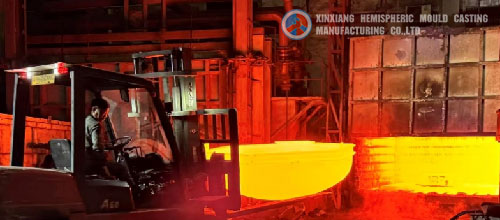
At 7 a.m. in the casting workshop, an overhead crane lifts the first ladle of glowing molten iron, with the orange-red light reflecting on the goggles of operator Lao Zhang. "Molten iron temperature: 1450℃, composition up to standard!" The voice of quality inspector Xiao Li comes through the walkie-talkie, and Lao Zhang skillfully adjusts the pouring speed—this is a daily routine on the cast iron production line of a heavy machinery manufacturer, and also the first checkpoint for quality control of ferrous cast iron. As a fundamental material for bearing core mechanical components, the surface roughness, metallographic structure, and chemical properties of cast iron directly determine the service life and safety performance of products. The compliance of each performance index embodies the manufacturer's meticulous control over process details.
1. Surface Roughness: A Millimeter-Level Battle from "Molding Sand" to "Pouring"
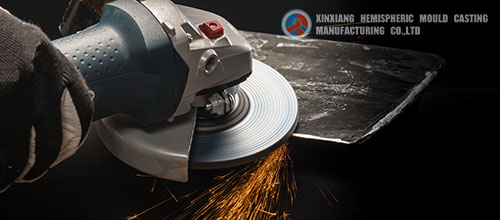
The surface roughness of cast iron parts (usually measured by Ra value) is not only the first standard for customers to intuitively perceive product quality but also the basis for subsequent machining accuracy. During the production of gray cast iron machine tool beds in our factory, a batch of parts once had an Ra value exceeding the limit to 6.3μm (required ≤3.2μm), resulting in a 30% surge in the wear rate of machining tools at the downstream customer. A review revealed that the root cause of the problem lay in the seemingly ordinary molding sand.
The casting of ferrous cast iron relies on sand mold forming, and the proportion, compactness, and air permeability of molding sand directly affect the flatness of the cast surface. The current molding sand formula in our factory adopts a "quartz sand + bentonite + pulverized coal" system, where bentonite, as a binder, must be strictly controlled at 8%-10%: if less than 8%, the molding sand will have insufficient strength, leading to pitting due to erosion by molten iron during pouring; if more than 10%, the air permeability of the molding sand will decrease, preventing gas in the molten iron from escaping and forming 气孔 depressions on the surface. To precisely control the proportion, the workshop has introduced an automatic molding sand mixer, which monitors the bentonite content in real-time with an error controlled within ±0.5%.
The pouring process presents another challenge. If the pouring temperature of molten iron is too low (below 1380℃), the fluidity of the molten iron will be poor, failing to fill the fine patterns of the sand mold and resulting in "missing material" or a rough surface; if the temperature is too high (above 1480℃), it will intensify the thermal expansion and sintering of the sand mold, causing sand particles to adhere to the cast surface and form hard-to-clean "sand adhesion" after cooling. To address this, we have installed an infrared thermometer in the pouring ladle to record the temperature every 5 minutes, while adjusting the pouring speed according to the wall thickness of the castings: for small parts with a wall thickness of less than 20mm, the pouring speed is controlled at 5kg/s to avoid the molten iron scouring the sand mold; for large parts with a wall thickness of more than 50mm, a slow filling speed of 3kg/s is adopted to ensure the stable flow of molten iron.
Today, through the dual control of molding sand and pouring, the qualification rate of surface roughness of cast iron parts in our factory remains stable above 99.2%, with the highest Ra value reaching 1.6μm—equivalent to the smoothness after sandpaper polishing. Behind this lies our strict adherence to every grain of sand and every degree of temperature.
2. Metallographic Structure: A "Structural Revolution" Under the Microscope
If surface roughness is the "outerwear" of cast iron, then metallographic structure is its "skeleton". For key components such as ductile iron crankshafts that bear alternating loads, the graphite morphology and matrix structure in the metallographic structure directly determine their tensile strength and fatigue life. In the metallographic laboratory of our factory, technician Xiao Wang cuts 20 casting samples every day and observes the "morphological code" of graphite under a 400x microscope.
The core of the metallographic structure of ferrous cast iron is "graphite + matrix". Taking ductile iron as an example, the ideal structure should be "spheroidal graphite + pearlite matrix": when graphite is spherical, its splitting effect on the matrix is minimized, allowing the iron matrix to exert its strength to the maximum extent; if graphite is flake-shaped (similar to gray cast iron) or nodular-fibrous (similar to malleable cast iron), stress concentration will occur at the graphite tips, making the casting prone to fracture. The control of graphite morphology lies in two key processes: "inoculation treatment" and "spheroidization treatment".
In the melting section, we first put pig iron and scrap steel into an intermediate frequency induction furnace at a ratio of 3:1. When the molten iron temperature rises to 1420℃, ferrosilicon is added for inoculation treatment—silicon can promote graphite nucleation and prevent graphite from becoming coarse. Subsequently, magnesium alloy is added for spheroidization treatment, and the addition amount of magnesium must be accurate to 0.05%: too little will prevent graphite from spheroidizing, while too much will produce magnesium oxide inclusions, affecting the continuity of the matrix. To ensure uniform composition, we use the "冲入法" (impulse method) to add spheroidizing agents, wrapping magnesium alloy in ferrosilicon and putting it into the molten iron, while stirring with nitrogen for 3 minutes to prevent magnesium from burning.
The cooling rate determines the type of matrix structure. For crankshafts requiring high strength, we adopt the "water curtain cooling" process: immediately after demolding, the castings are sprayed with 40℃ circulating water, achieving a cooling rate of 15℃/min to promote pearlite formation (pearlite content ≥90%); for valve bodies requiring high toughness, "sand box slow cooling" is used, with the cooling rate controlled at 2℃/min to form a partial ferrite matrix. Today, through real-time feedback from metallographic analysis, the graphite spheroidization rate of ductile iron in our factory remains stable above 90% (meeting Grade 1 in GB/T 1348-2022), and the qualification rate of matrix structure exceeds 98%, completely solving the crankshaft fracture problem caused by unqualified metallography in the early years.
3. Chemical Properties: "Composition Guardian" for Corrosion Resistance and Oxidation Resistance
In the field of chemical equipment, the chemical properties of cast iron parts—especially corrosion resistance and oxidation resistance—are directly related to the safe operation of equipment. A cast iron reaction kettle produced by our factory for a chemical enterprise once suffered from rust perforation after 6 months of use in an acidic medium, leading to customer complaints. Post-incident testing showed that the chromium content in the casting was only 0.1%, far lower than the corrosion resistance requirement of 0.5%-1.0%. This accident made us deeply aware of the importance of chemical property control.
The chemical properties of ferrous cast iron are mainly determined by its chemical composition: chromium and nickel can form a passive film on the casting surface to improve corrosion resistance; copper can enhance oxidation resistance; while sulfur and phosphorus are "harmful elements"—sulfur combines with iron to form FeS, causing hot brittleness of the casting; phosphorus forms Fe3P, leading to cold brittleness of the casting. Therefore, in the batching process, we have established a "composition pre-control system": according to the customer's application scenario, the chemical composition range is determined in advance. For example, for cast iron parts used in chemical industry, the chromium content is controlled at 0.8%, nickel at 0.3%, copper at 0.5%, sulfur ≤0.03%, and phosphorus ≤0.08%.
Composition testing during the melting process is a key defense line. We are equipped with a direct-reading spectrometer at the furnace front, sampling the molten iron twice per furnace and measuring the content of 16 elements within 30 seconds. Last winter, the sulfur content of a batch of molten iron reached 0.045%, exceeding the upper limit of the standard. The furnace operator immediately added ferromanganese (manganese combines with sulfur to form MnS, reducing FeS formation) and allowed pouring only after re-testing confirmed that the sulfur content had dropped to 0.028%. In addition, after the castings are formed, we also sample 10% of the products for "salt spray testing": placing the samples in a 5% sodium chloride solution and continuously spraying for 48 hours at 35℃, requiring the rust area to be ≤5%. This strict testing standard has gradually restored the reputation of our corrosion-resistant cast iron parts in the chemical industry, with the current customer repurchase rate reaching 85%.
Conclusion: Quality Control is the "Lifeline" of Cast Iron
At 6 p.m., the last batch of cast iron parts passes the surface roughness test, metallographic analysis, and composition review, with qualification labels attached to the castings. Workshop director Lao Wang looks at these products to be shipped to customers and sighs: "Casting cast iron is like simmering a pot of old soup—temperature (heat), ingredients (composition), and utensils (sand mold) are all indispensable." From the proportion of molding sand to the melting of molten iron, from the observation of metallography to the testing of corrosion resistance, every quality control link represents the manufacturer's practice of the "craftsmanship spirit".
In today's era when the manufacturing industry is moving towards high-end development, cast iron is no longer synonymous with "crudeness and heaviness". Instead, through precise quality control, it has become a "reliable cornerstone" for bearing precision machinery and chemical equipment. For us manufacturers, what we control is the surface roughness, microscopic metallography, and the proportion of chemical components, while what we safeguard is the trust of customers and the future of the industry—this is the quality code of cast iron casting.